top of page

Instrument

PXL_20260324_165448999.jpg

PXL_20260324_165313120.jpg

PXL_20260324_165236371.jpg
PXL_20260324_165448999.jpg
1/5
Sun Yat-sen's Briefcase
Instrument
Brass, Leather
A worn leather briefcase preserved by the Liverpool Chee Kung Tong house, traditionally said to have belonged to Dr. Sun Yat-sen upon his arrival in Liverpool from the United States in 1896. Regardless of whether this attribution can be strictly verified, the object holds profound commemorative value within the local community. It bridges the specific history of the Liverpool branch with the broader political mythology of the Chinese diaspora and the revolutionary legacy of Sun Yat-sen. Its heavy wear, faded surface, and aged fittings reinforce its significance as a poignant relic of travel, migration, and historical connection.

PXL_20260324_140756152.jpg
PXL_20260324_140756152.jpg
1/1
Fly-whisk and bow
Instrument
Cane, Fur, Feather
Ceremonial flywhisk and bow used during Hung Mun ceremonies. In Taoist traditions, the whisk forms part of a priest’s regalia and symbolises purification.

PXL_20260324_140210803.jpg
PXL_20260324_140210803.jpg
1/1
Straw Sandals, Red Sticks and Palm Leaf Fan
Instrument
Cane, Dried Grass, Bamboo
This group of objects, comprising straw sandals, red sticks, and a palm-leaf fan, may be interpreted in relation to the symbolic rank culture of the Hung Mun tradition. Straw sandals (“草鞋”) denoted the messenger or liaison officer, associated with mobility and communication, while the red stick (“紅棍”) signified the martial officer responsible for combat and protection. The white paper fan (“白紙扇”) represented the strategist or adviser, although this surviving example is a palm-leaf fan rather than the standard white fan referenced in later rank terminology.

PXL_20260324_135010964.jpg

PXL_20260324_135033279.jpg

PXL_20260324_135002219.jpg
PXL_20260324_135010964.jpg
1/5
Brass Bo ("銅鈸")
Instrument
Brass
This set of brass cymbals bears the inscription "Follow Heaven and uphold the righteous way" (“順天行道”). In the context of Hung Mun ritual culture, the phrase expressed the brotherhood’s claim to moral and cosmological legitimacy, linking collective action to Heaven’s mandate.

PXL_20260324_134849144.jpg
PXL_20260324_134849144.jpg
1/1
Bamboo flute
Instrument
Bamboo
This bamboo flute is a simple wind instrument, decorated near one end with an incised landscape motif. Preserved within the Chee Kung Tong Liverpool collection, it points to the role of sound and performance alongside ritual objects. As with the opera-related garments and headgear in the collection, the flute suggests a close relationship between associational life, performance culture, and communal gathering.

PXL_20260324_134742137.jpg

PXL_20260324_134733842.jpg
PXL_20260324_134636720.jpg
PXL_20260324_134742137.jpg
1/4
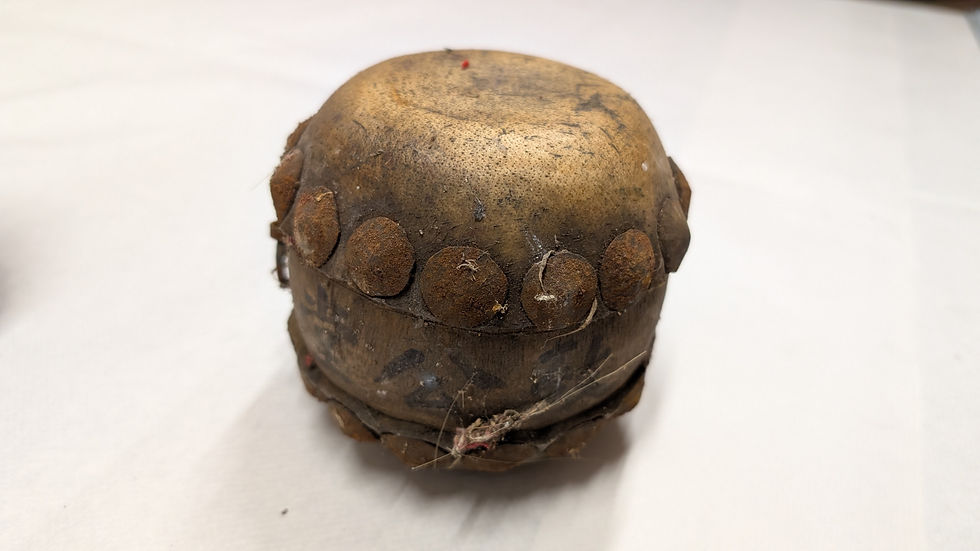
Small drums
Instrument
Brass, Leather, Wood
These are two small hand drums, probably used in ritual or performance. Their compact and portable form, along with their tacked construction, suggests use as practical percussion instruments rather than decorative objects. The name Chee Kung Tong ("致公堂") is inscribed on their sides.

PXL_20260324_134450071.jpg

PXL_20260324_134254141.jpg

PXL_20260324_134022703.jpg
PXL_20260324_134450071.jpg
1/4
Musical Instruments
Instrument
Brass, Leather, Wood
This group comprises suona horns ("嗩吶"), drums, gongs, cymbals, and a music-stand base, representing the instrumental ensemble used in ritual and performance within the Tong house. As a whole, the set underscores the importance of organised sound in ceremonial practice, where percussion and wind instruments structured rhythm, transition, and collective display.

PXL_20260324_133101974.jpg
PXL_20260324_133101974.jpg
1/1
Pairing Eight-Chopping Knives and Machetes
Instrument
Steel, Wood
This group comprises a pair of Eight-Cutting Knives (八斬刀), the traditional paired blades of Wing Chun martial practice, together with two machetes. The knives are associated with the advanced weapons curriculum of Wing Chun and are closely linked to southern Chinese martial culture. In this example, however, the blades are unsharpened, suggesting they were intended for training, display, or ceremonial use rather than combat.

PXL_20260324_133001510.MP.jpg

PXL_20260324_132718422.jpg
PXL_20260324_133001510.MP.jpg
1/2
Wooden Immitation Blades
Instrument
Textile, Wood
These imitation swords and blades appear to form part of the martial apparatus used in Hung Mun initiation rituals. A ritual account describes black-robed guards holding swords at the entrance, beneath which initiates crawled as they symbolically passed through danger, while other swords were used in the staged decapitation of paper effigies representing the brotherhood’s enemies. In this context, these unsharpened blades are best understood not as functional weapons but as ceremonial props, materialising the ritual language of ordeal, protection, punishment, and sworn loyalty.
bottom of page